Showing posts with label Lost Episodes. Show all posts

Jan 23, 2012

Lost Episode for January 23

0 comments
In a letter to fellow Founding Father John Adams on January 23, 1807, Benjamin Rush wrote:
“By renouncing the Bible, philosophers swing from their moorings upon all moral subjects. Our Saviour in speaking of it calls it the “Truth” in the abstract. It is the only correct map of the human heart that ever has been published. It contains a faithful representation of all its follies, vices, and crimes. All systems of religion, morals, and government not founded upon it must perish, and how consoling the thought – it will not only survive the wreck of these systems but the world itself. ‘The Gates of Hell shall not prevail against it.’ [Matthew 16:18]*
Founder Benjamin Rush’s belief that the Bible is an essential foundation for enduring government is a lost episode in American history.
*Source Citation: L.H. Butterfield, ed., Letters of Benjamin Rush, (Princeton, NJ: Princeton University Press, 1951), 2:936. Bracketed item added.

Oct 26, 2011

Day of prayer

0 comments
Lost Episodes: Day of Thanksgiving and Prayer
October 26, 2011


On Friday, October 26, 1781, the Journal of the Continental Congress reports that a committee, consisting of “Mr. Witherspoon, Mr. Montgomery, Mr. Varnum, Mr. Sherman,” was appointed to prepare a recommendation for setting apart a day of public thanksgiving and prayer in light of the momentous victory over the British at Yorktown, which was agreed to as follows:


“Whereas, it hath pleased Almighty God, the supreme Disposer of all Events father of mercies, remarkably to assist and support the United States of America in their important struggle for liberty, against the long continued efforts of a powerful nation: it is the duty of all ranks to observe and thankfully acknowledge the interpositions of his Providence in their behalf. Through the whole of the contest, from its first rise to this time, the influence of divine Providence may be clearly perceived in many signal instances…and in which, after the success of our allies by sea, a General of the first Rank, with his whole army, has been captured by the allied forces under the direction of our illustrious Commander in Chief.

It is therefore recommended to the several states to set apart the 13th day of December next, to be religiously observed as a Day of Thanksgiving and Prayer; that all the people may assemble on that day, with grateful hearts, to celebrate the praises of our gracious Benefactor; to confess our manifold sins; to offer up our most fervent supplications to the God of all grace, that it may please Him to pardon our offences, and incline our hearts for the future to keep all his laws; to comfort and relieve all our brethren who are in distress or captivity; to prosper our husbandmen, and give success to all engaged in lawful commerce; to impart wisdom and integrity to our counsellors, judgment and fortitude to our officers and soldiers; to protect and prosper our illustrious ally, and favor our united exertions for the speedy establishment of a safe, honorable and lasting peace; to bless all seminaries of learning; and cause the knowledge of God to cover the earth, as the waters cover the seas.”*
This proclamation was written by Rev. Dr. John Witherspoon, delegate from New Jersey, President of what is now Princeton, and a minister of the Gospel. The fact that Congress recommended that Americans set aside a “Day of Thanksgiving and Prayer” for their victory in the War for Independence is another lost episode in American history.


*Source Citation: Journals of the Continental Congress 1774-1789, 34 vols., (Washington, DC: Government Printing Office, 1907-37), 21:1074-76.

Oct 18, 2011

Indispensable Books

0 comments
Lost Episodes | Indispensable Book
October 18, 2011

American newspaper journalist Charles Dana died on October 17, 1897. In 1839, he had entered Harvard, but the impairment of his eyesight forced him to leave college in 1841, and caused him to abandon his intention of entering the ministry. He later served as editor-in-chief of the New York Sun, and under his management it became one of the largest and most influential newspapers in the country. Dana also served as Assistant Secretary of War during the Civil War. Regarding the essential tools for a journalist, Charles Dana declared to the Wisconsin Editorial Association:

“[T]here are some books that are absolutely indispensable to the kind of education that we are contemplating, and to the profession that we are now considering; and of all these, the most indispensable, the most useful, the one whose knowledge is most effective, is the Bible. There is no Book from which more valuable lessons can be learned. I am considering it now as a manual of utility, or professional preparation, and professional use for a journalist.

There is no Book whose style is more suggestive and more instructive, from which you learn more directly that sublime simplicity which never exaggerates, which recounts the greatest event with solemnity, of course, but without sentimentality or affection, none which you open with such confidence and lay down with such reverence; there is no Book like the Bible.

When you get into a controversy and want exactly the right answer, when you are looking for an expression, what is there that closes a dispute like a verse from the Bible? What is it that sets up the right principle for you, which pleads for a policy, for a cause, so much as the right passage of the Holy Scripture?”*
The fact that there actually was a major newspaper editor who had such great respect for the Bible and even advocated its use by fellow journalists is yet another lost episode in American history.

*Source Citation: Charles Dana, The Art of Newspaper Making: Three Lectures (New York: D. Appleton & Company, 1895), 48-49.

Oct 11, 2011

For Whom Our Constitution Was Made

0 comments
Lost Episodes | October 11, 2011


On October 11, 1798, President John Adams stated in a letter to the officers of the First Brigade of the Third Division of the Militia of Massachusetts:


"We have no government armed with power capable of contending with human passions unbridled by morality and religion. Avarice, ambition, revenge, or gallantry, would break the strongest cords of our Constitution as a whale goes through a net. Our Constitution was made only for a moral and religious people. It is wholly inadequate to the government of any other." 1


Other nations have copied our Constitution almost verbatim but have not enjoyed our success. John Adams gives us the reason. Our Constitution only works if “We the People” are moral and virtuous, which only results from religious principle and practice. John Adam’s statement on the Constitution is another lost episode in American history.


1 Source Citation: Charles Francis Adams, ed., The Works of John Adams – Second President of the United States: with a Life of the Author, Notes, and Illustration, 10 vols., (Boston: Little, Brown, & Co., 1854), 9:228-229.

Aug 23, 2011

Lost Episodes: Franklin’s View of Education

0 comments
Written by aaron | August 23, 2011


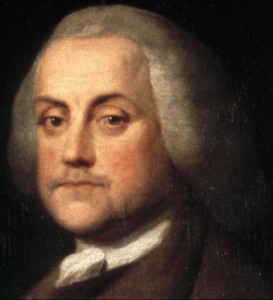
On August 23, 1750, Benjamin Franklin wrote to Dr. Samuel Johnson, who was the first President of King’s College (later Columbia University), regarding education:
“I think with you, that nothing is of more importance for the public weal [good], than to form and train up youth [Prov. 22:6] in wisdom and virtue. Wise and good men are, in my opinion, the strength of a state: much more so than riches or arms, which, under the management of Ignorance and Wickedness, often draw on destruction, instead of providing for the safety of a people. And though the culture bestowed on many should be successful only with a few, yet the influence of those few and the service in their power, may be very great. Even a single woman that was wise, by her wisdom saved a city [2 Sam. 20:22].
I think also, that general virtue is more probably to be expected and obtained from the education of youth, than from the exhortation of adult persons; bad habits and vices of the mind, being, like diseases of the body, more easily prevented than cured.
I think moreover, that talents for the education of youth are the gift of God; and that he on whom they are bestowed, whenever a way is opened for the use of them, is as strongly called as if he heard a voice from heaven: nothing more surely pointing out duty in a public service, than ability and opportunity of performing it.”*
Benjamin Franklin knew the importance of training up young, virtuous leaders and viewed effective educators as having a divine calling and a gift from God. That is another lost episode in American history.

*Source Citation: Leonard W. Labaree, ed. et al, The Papers of Benjamin Franklin, 40 vols. to date, (New Haven, CT: Yale University Press, 1959-2011), 4:40. Bracketed items added.

Aug 12, 2011

Lost Episodes: Lincoln’s Call to Pastors

0 comments
Written by aaron | August 12, 2011
 
After the defeat of the Union Army at the Battle of Bull Run, Congress asked for and President Abraham Lincoln issued a Proclamation on Monday, August 12, 1861, calling for a National Day of Humiliation, Prayer, and Fasting, which states in part:

“Whereas it is fit and becoming in all people, at all times, to acknowledge and revere the Supreme Government of God; to bow in humble submission to His chastisement; to confess and deplore their sins and transgressions in the full conviction that the fear of the Lord is the beginning of wisdom; and to pray, with all fervency and contrition, for the pardon of their past offenses, and for a blessing upon their present and prospective action; and

Whereas when our own beloved country, once, by the blessings of God, united, prosperous and happy, is now afflicted with faction and civil war, it is peculiarly fit for us to recognize the hand of God in this terrible visitation, and in sorrowful remembrance of our own faults and crimes as a nation and as individuals, to humble ourselves before Him and to pray for His mercy – to pray that we may be spared further punishment, though most justly deserved; that our arms may be blessed and made effectual for the reestablishment of law, order, and peace throughout the wide extent of our country; and that the inestimable boon of civil and religious liberty, earned under His guidance and blessing by the labors and sufferings of our fathers, may be restored in its original excellence:

Therefore I, Abraham Lincoln, President of the United States, do appoint the last Thursday in September next as a day of humiliation, prayer, and fasting for all the people of the nation. And I do earnestly recommend to all the people, and especially to all ministers and teachers of religion of all denominations and to all heads of families, to observe and keep that day according to their several creeds and modes of worship in all humility and with all religious solemnity, to the end that the united prayer of the nation may ascend to the Throne of Grace and bring down plentiful blessings upon our country.

In testimony whereof I have hereunto set my hand and caused the seal of the United States to be affixed, this 12th day of August, A.D. 1861, and in the Independence of the United States of America the eighty-sixth.

Abraham Lincoln.
By the President:
William H. Seward, Secretary of State*

Abraham Lincoln’s Proclamation and his special call for the assistance of the pastors to call the people to united prayer for the nation is another lost episode in American history.

*Source Citation: Abraham Lincoln in an August 12, 1861 Proclamation as found in James D. Richardson, ed., A Compilation of the Messages and Papers of the Presidents 1789-1897, 10 vols. (Washington, D.C.: U.S. Government Printing Office, 1897, 1899), 6:36-37.

Aug 9, 2011

Lost Episodes: Our Hope in Suffering

0 comments
Written by aaron | August 9, 2011


Once bitter political rivals, but now reconciled as friends, John Adams and Thomas Jefferson were prolific in their correspondence later in life. Not surprisingly, the subject turned to matters of faith. On August 9, 1816, John Adams wrote his former sparring partner about a renowned Dutch pastor, and then turned to the sufferings of this life and the hope of eternity: 


“Promise me eternal life free from pain… [W]ithout the supposition of a future state, mankind and this globe appear to me the most sublime and beautiful bubble and bauble that imagination can conceive. Let us then wish for immortality at all hazards, and trust the Ruler with His skies. I do; and earnestly wish for His commands, which to the utmost of my power shall be implicitly and piously obeyed.”* 
John Adams testified that there was more than suffering and superficiality of this life, that there is a God who reigns, that He is our hope of eternal life free of pain, and that we are accountable to obey His commands. That is another lost episode in American history. 


*Source Citation: John Adams to Thomas Jefferson on August 9, 1816 as found in Albert Ellery Bergh, ed., The Writings of Thomas Jefferson, 20 vols., (Wash­ington, DC: Thomas Jefferson Memorial Assoc., 1907), 15:64.

Aug 4, 2011

Lost Episodes: Government Under God’s Will

0 comments
Written by aaron | August 4, 2011

The English colonists settling in what is Exeter, New Hampshire, set forth their government on August 4, 1639, declaring:

“Whereas it hath pleased the Lord to move the heart of our dread sovereign Charles by the grace of God King &c to grant license and liberty to sundry of his subjects to plant themselves in the western parts of America…

We his loyal subjects, brethren of the church in Exeter,…considering with ourselves the holy will of God and our own necessity that we should not live without wholesome laws and civil government among us of which we are altogether destitute, do in the name of Christ and in the sight of God combine ourselves together to erect and set up among us such government as shall be to our best discerning agreeable to the will of God…

[A]nd binding of ourselves solemnly by the grace and help of Christ and in his name and fear to submit ourselves to such godly and christian laws as are established in the realm of England [1 Peter 2:13-17]…and to all other such laws which shall upon good grounds be made and enacted among us according to God that we may live quietly a peaceably together in all godliness and honesty [1 Tim. 2:1-2].”*

The Biblical worldview of these early settlers in New Hampshire regarding the purpose of government is yet another lost episode in American history.

*Source Citation: Thirty-three signatories in Exeter on August 4, 1639 as found in Jeremy Belknap, The History Of New Hampshire: From a Copy Of The Original Edition Having The Authors Last Corrections To Which Are Added Notes Containing Various Corrections and Illustrations Of The Text And Additional Pacts And Notices Of Persons And Events Therein Mentioned, John Farmer, ed. (Philadelphia: Robert Aitken, 1784; Dover, NH: S.C. Stevens and Ela & Wadleigh 1831), 432.
 

Copyright 2009 All Rights Reserved Revolution Two Church theme by Brian Gardner | Blogger template converted & enhanced by eBlog Templates